
Material selection is one of the most important decisions in any plastic injection project. Although part design, mould design and production parameters have a direct impact on the final result, the properties of the material determine aspects as important as mechanical strength, chemical compatibility, aesthetics or the economic viability of the project.
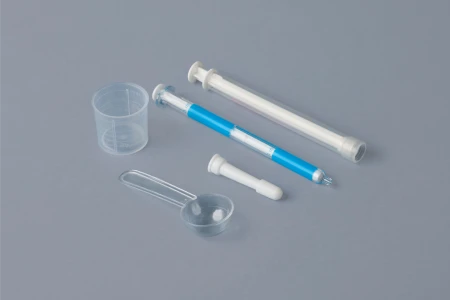
Two parts can have an almost identical geometry and be manufactured using the same injection process, yet still require different materials depending on the demands of their end application. A cosmetic container, a vaginal applicator, a dosing syringe or a food container can have very different requirements in terms of strength, safety or appearance.
Understanding the characteristics of materials and how they influence manufacturing and final performance is essential to ensuring the success of any industrial development.
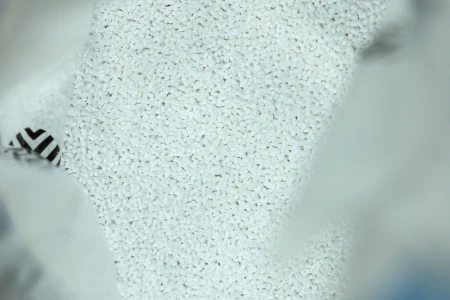
Main materials used in plastic injection moulding
Before looking at parameters or additives, it’s worth starting with the basics: the polymers behind most packaging developments.
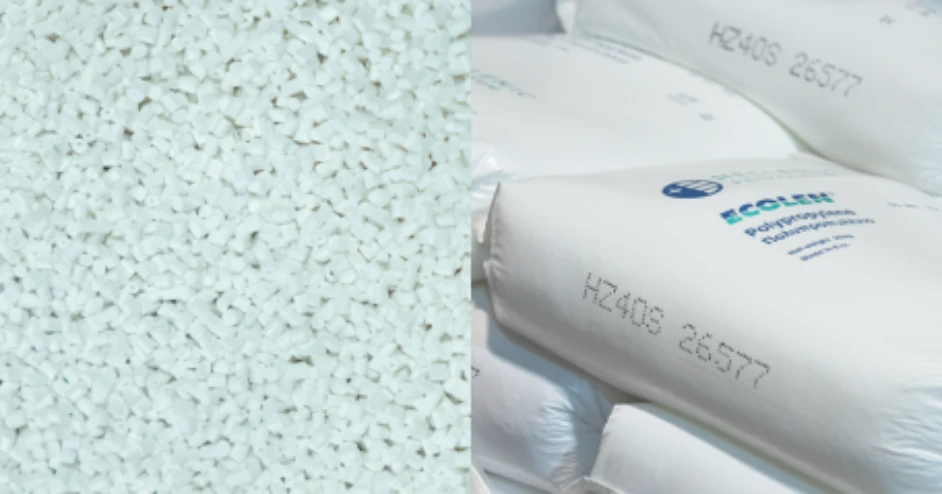
Polypropylene (PP)
This is one of the most widely used materials in the plastics industry thanks to its excellent balance of cost, performance and ease of processing.
It offers good chemical resistance against a wide range of substances, low density and great versatility across different applications. It also behaves very consistently during injection and allows parts to be produced with a good balance between stiffness and strength.
These characteristics explain its widespread use in many sectors, where it is commonly used to manufacture granule containers, granule caps, dosing systems and numerous technical components.
Polyethylene (PE)
Polyethylene stands out for its high chemical resistance and its ability to absorb impacts without cracking easily.
Depending on the application, different grades can be used, such as HDPE or LDPE, each with specific properties in terms of flexibility and stiffness.
Polystyrene (PS)
Polystyrene is a rigid material that offers excellent surface finish and a great ability to reproduce fine detail. Its good aesthetic properties allow parts to be produced with very attractive visual finishes.
PET (Polyethylene Terephthalate)
PET is one of the most recognised materials in the packaging sector thanks to its high transparency and excellent mechanical properties. It’s a solution widely used in cosmetics and personal care products.
PET is currently one of the most recycled materials worldwide, and it allows recycled content (rPET) to be incorporated into numerous applications, contributing to sustainability goals.
At Triana, we hold UNE-EN 15343 certification for our cosmetic jars, which verifies and documents the recycled plastic content used in our manufactured products, providing assurance to both customers and end consumers.
We are also ISCC PLUS certified, an internationally recognised sustainability certification system that guarantees the traceability of sustainable materials throughout the supply chain.
How to read a material technical data sheet
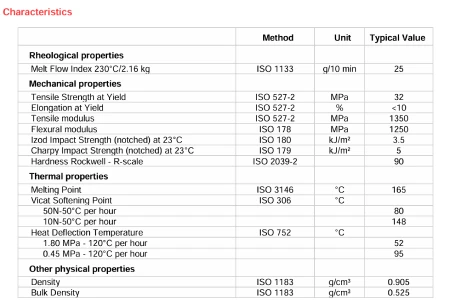
Once we know the base polymers, the next step is knowing how to read them in practice. Technical data sheets contain much of the information needed to understand how a material behaves, but interpreting them correctly requires understanding how they actually affect the manufacturing process and the final performance of the part. Two of the most relevant parameters when evaluating a material are melt flow and mechanical behaviour.
MFI (Melt Flow Index)
The melt flow index indicates how easily the material flows in its molten state during injection. An MFI suited to the part’s geometry and the type of mould is decisive for achieving a correct fill, avoiding defects and maintaining process repeatability batch after batch.
Flexural modulus and impact resistance
Flexural modulus measures the stiffness of a material, while impact resistance indicates its ability to absorb shocks and mechanical stress without breaking. Both parameters tend to move in opposite directions: the higher the stiffness, the lower the toughness, and vice versa. Finding the right balance between the two is precisely one of the most common technical challenges in material selection, especially for parts that need to be strong without being brittle.
Elongation at Yield
Elongation at yield indicates how much a material can deform before losing its elastic behaviour and starting to crack. It’s a key value for parts that need to flex repeatedly without breaking, such as integrated hinges or snap-fit closures. Data sheets often also show tensile modulus alongside flexural modulus: both indicate stiffness, but they are obtained by applying force in different ways, and the values don’t always match.
Thermal properties
Beyond mechanical behaviour, the data sheet also shows how the material behaves under heat. The melting point sets the reference temperature for processing on the injection moulding machine, while Vicat softening temperature and HDT (Heat Deflection Temperature) indicate at what temperature the part starts to lose stiffness and deform under load. These figures are especially relevant for applications that go through sterilisation, autoclaving or hot filling, where the container needs to hold its shape and properties even at high temperatures.
Density
A material’s density has a direct impact on the cost per part: for the same volume, a denser material weighs — and costs — more. Bulk density, meanwhile, affects how the pellets flow through the machine’s feed hopper, influencing the stability of the dosing process.
Additives and modifiers: much more than the raw material
The base polymer is just the starting point. The final performance of a part doesn’t depend solely on the PP, PE, PS or PET used: in many cases, the addition of functional additives and modifiers is what makes the difference in adapting a material to the regulatory, mechanical and aesthetic demands of each industry.
Colour masterbatch
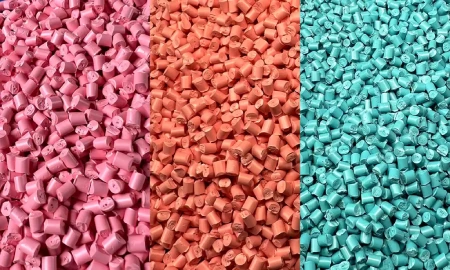
This is the most efficient industrial solution for adding colour to plastic materials. It not only produces a consistent colour, but also guarantees repeatability across different production batches, keeping colour consistency tight. A good masterbatch is also formulated so as not to significantly alter the MFI (Melt Flow Index) or the rheological behaviour of the polymer during mould filling.
UV additives
Prolonged exposure to sunlight or intense ambient lighting can cause polymer degradation, colour loss (yellowing) or a sharp drop in mechanical properties. UV stabilisers work by interrupting the photodegradation process, extending the service life and physical integrity of the container.
Anti-static additives
During injection and subsequent handling, friction generates a build-up of static electricity. This attracts ambient dust (affecting the product’s appearance) and can cause issues on customers’ automated packaging lines. Anti-static additives migrate to the surface to dissipate this charge, improving hygiene and the workability of the final product.
Slip and anti-block additives
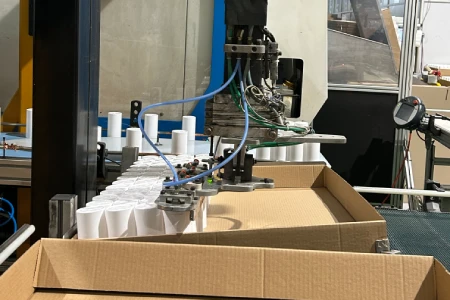
These additives modify the surface characteristics of the material to make handling, transport or certain automated manufacturing processes easier. They are essential for demoulding complex parts, preventing containers from sticking together during automated stacking and optimising transport on high-speed automated assembly lines.
Impact modifiers
Their role is to increase the material’s resilience, i.e. its ability to absorb severe shocks and mechanical stress without breaking, even at low temperatures. By rebalancing the relationship between flexural modulus (stiffness) and impact resistance, they allow inherently more brittle materials to gain tough behaviour, which is crucial for medical applications.
Materials for food contact and regulated applications
Once the material has been defined and, if necessary, modified with additives, selection in certain industries goes far beyond physical or mechanical properties.
Food Contact

Materials intended for food contact must meet specific regulatory requirements to guarantee consumer safety.
In addition to using authorised raw materials, technical documentation and traceability systems must be in place to demonstrate compliance with applicable regulations.
For this reason, document management and material control carry as much weight as the product’s own technical properties.
Pharmaceutical and healthcare applications
These sectors demand especially high levels of control. Factors such as chemical compatibility, dimensional stability, process cleanliness or material traceability can be decisive for a project’s approval.
The right material must be selected taking into account not only technical performance, but also the associated regulatory requirements.
Materials and sustainability
Sustainability is no longer an added value — it has become the core of any plastic product’s development. Today, the design of new packaging and technical components not only aims for functional efficiency, but also has to respond to a demanding European regulatory framework, led by the Packaging and Packaging Waste Regulation (PPWR), which requires reducing the consumption of primary resources and maximising recyclability.
To achieve these goals without compromising product quality, it’s essential to master the following selection and eco-design strategies:
Recyclable material vs recycled material
Although often mistakenly used as synonyms, at a conceptual and industrial level they represent completely different stages.
- Recyclable material: refers to a part or container’s ability to be recovered, shredded and turned back into raw material once its useful life is over. Whether a material is technically recyclable depends on its nature (PP or PET are), but also on how easily automatic sorting systems can identify and process it at sorting facilities.
- Recycled material: a polymer whose formulation already incorporates raw material from previous recovery processes. The challenge when working with recycled material in industrial injection is ensuring its rheological and mechanical properties remain stable, so as not to affect production parameters or the final quality of the part.
PCR (Post-Consumer Recycled)
PCR materials come directly from waste generated by consumers (both households and businesses) that has been collected, sorted and industrially processed to be reintroduced into the production cycle.
Using PCR materials reduces the consumption of virgin raw materials and helps move towards more sustainable manufacturing models.
This is key to reducing environmental impact and meeting the PPWR’s upcoming mandatory targets for recycled plastic content.
Mono-materials, key to circularity
One of the most significant trends in the packaging sector is the development of mono-material solutions. Historically, many containers required combining different plastics or materials to achieve certain barrier or sealing properties, which made recycling much more difficult afterwards.
By using a single family of materials, recycling processes are simplified and the product’s circularity is improved once its useful life ends.
Conclusions
As we’ve seen throughout this article, choosing correctly involves several aspects: it’s not just about selecting a polymer with good mechanical or aesthetic properties, but about finding the right balance with ease of injection, behaviour during subsequent decoration (such as dry offset printing or screen printing), compliance with safety regulations and the brand’s sustainability goals.
In a highly regulated market that keeps evolving, approaching material selection from a global perspective — combining theory with real, hands-on machine experience — is the only way to develop future-proof solutions. At Industrias Plásticas Triana, we support our customers from the earliest design stages to ensure that the combination of raw material, additives and injection technology results in a product aligned with today’s market demands.