
Today, sustainability is no longer just a competitive advantage—it is both a regulatory requirement and a market expectation. The European Union has introduced a comprehensive set of regulations that are reshaping how plastic packaging is designed, manufactured and managed at the end of its life cycle.
In this article, we explore the key concepts, regulations and certifications that define today’s sustainability landscape for plastic packaging, from the Packaging and Packaging Waste Regulation (PPWR) to Spain’s Plastic Tax, including post-consumer recycled (PCR) materials, mono-material design, eco-modulation and the certification schemes currently available.
The PPWR (EU Regulation 2025/40): Europe’s New Packaging Framework
Regulation (EU) 2025/40, better known as the Packaging and Packaging Waste Regulation (PPWR), is the most significant piece of packaging legislation ever adopted by the European Union. Unlike previous directives, it is a regulation, meaning it applies directly and uniformly across all EU Member States.
Although it entered into force on 12 February 2025, most of its obligations will apply progressively from 12 August 2026 onwards.
The regulation is built around four key principles:
- Mandatory Recyclability by Design: By 2030, all packaging placed on the EU market must be designed to be recyclable, while by 2035 it must also be recyclable at industrial scale.
The PPWR introduces three recyclability performance grades:
- Grade A: more than 80% recyclable
- Grade B: between 70% and 80%
- Grade C: between 50% and 70%
Packaging achieving less than 70% recyclability will no longer be allowed on the European market from 2030.
- Minimum Recycled Content (PCR): From 2030, non-food plastic packaging must contain at least 35% post-consumer recycled (PCR) plastic. For food-contact-sensitive packaging, the minimum recycled content will be 10%, while single-use beverage bottles must contain 30% PCR.These targets will progressively increase, reaching up to 65% by 2040.
- Reducing Weight and Empty Space: The regulation requires packaging to use only the amount of material necessary to perform its intended function.
It also limits empty space inside packaging to a maximum of 50%, encouraging more efficient packaging design and reducing unnecessary material consumption.
- Harmonised Labelling: From 2028 onwards, packaging sold within the EU will have to include harmonised labels providing clear recycling information. Many packages will also feature QR codes linking to documentation demonstrating regulatory compliance.
Eco-Design: Designing Packaging for Its End of Life
The PPWR makes eco-design a mandatory requirement rather than a voluntary best practice.
Packaging manufacturers will be required to demonstrate that their products have been designed to maximise recyclability while minimising material consumption and ensuring compatibility with existing recycling streams.
Key eco-design principles for plastic packaging include:
- Reducing packaging weight to the minimum functional level.
- Choosing mono-material structures or components that can be easily separated.
- Selecting colours and additives that remain compatible with optical sorting technologies used in recycling facilities.
Mono-Material Design: The Foundation of Effective Recycling
Mono-material packaging is designed so that all its components are made from the same polymer.
Unlike multi-material structures commonly found in complex packaging, mono-material solutions greatly simplify sorting and recycling at the end of the product’s life.
Its advantages are significant:
- The entire package can be recycled through a single recycling stream without separating individual components.
- It improves automatic sorting efficiency in recycling plants.
- It helps achieve higher recyclability ratings under the PPWR framework.
PCR: Post-Consumer Recycled Material
Post-consumer recycled (PCR) material refers to plastic obtained by recycling waste generated by end consumers after a product has fulfilled its intended purpose.
Incorporating PCR into plastic packaging offers several direct benefits:
- It reduces the CO₂ emissions associated with producing virgin plastic.
- It helps manufacturers and brands comply with the PPWR requirements and, in Spain, qualify for tax relief under the Plastic Tax established by Law 7/2022.
- It provides tangible evidence of circularity, meeting the growing demand from customers and consumers for sustainable packaging solutions.
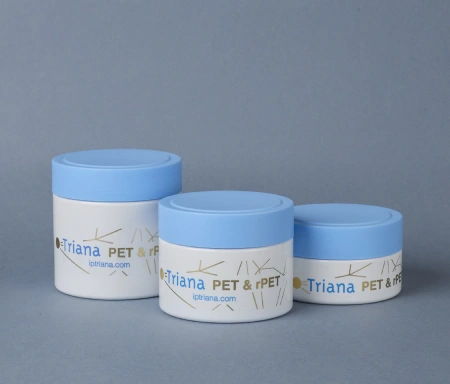
At Industrias Plásticas Triana, we are actively working to incorporate PCR into our packaging, with a particular focus on our containers for granules
and tablet dispensers, where technical requirements allow its implementation.

Plastic vs Glass vs Cardboard: Comparing Their Environmental Footprint
The debate over which packaging material is the most sustainable is far more complex than it is often portrayed. The answer depends largely on the assessment methodology, the intended application, local recycling rates and the product’s overall life cycle.
Weight: A Critical Factor
One aspect that is often overlooked in discussions about packaging materials is weight.
Plastic is by far the lightest packaging material available. A PP or PS container may weigh between 10 and 30 grams, while an equivalent glass container can easily exceed 200–300 grams.
This significant difference has a direct and measurable impact on:
- CO₂ emissions generated during transportation.
- The energy required to move products throughout the supply chain.
- The number of transport journeys needed to distribute the same volume of products.
Thanks to its lightweight nature, plastic allows manufacturers to produce thin-walled packaging that provides the same level of product protection while using less material. Fewer grams per unit not only reduce transport emissions but also decrease raw material consumption at the source.
Carbon Footprint and Life Cycle Assessment (LCA)
Life Cycle Assessment (LCA) studies comparing different packaging materials generally provide nuanced conclusions.
Overall, plastic tends to have a relatively low carbon footprint due to its lightweight nature, which significantly reduces transport-related emissions. Glass, by contrast, has a considerably higher production and transportation footprint, as it requires melting temperatures of around 1,500°C and weighs several times more than an equivalent plastic package.
However, reusable glass bottles can dramatically reduce their environmental impact when they are reused over multiple cycles.
Cardboard generally has a lower production footprint than glass. However, many cardboard packages consist of multilayer structures combining paper, aluminium and plastic, making them more difficult to recycle and reducing their actual recyclability. In addition, cardboard relies on wood as its primary raw material, making responsible forest management an important environmental consideration.
The conclusion drawn by most studies is that there is no universally superior packaging material in terms of sustainability. What is clear is that plastic packaging designed for recycling and optimised for lightweight performance offers one of the best balances between functionality and environmental impact when properly managed at the end of its life.
Energy Consumption During Production
The injection moulding process used to manufacture polypropylene (PP) and polystyrene (PS) packaging operates at significantly lower temperatures than glass production. It can also be integrated with renewable energy sources and heat recovery systems.

This lower energy demand during manufacturing is one of the strongest arguments in favour of plastic when comparing the carbon footprint per packaging unit produced.
To objectively measure environmental performance, the European Commission has developed a dedicated methodology known as the Product Environmental Footprint (PEF).
Product Environmental Footprint (PEF)
The Product Environmental Footprint (PEF) is the methodology promoted by the European Commission to assess the environmental impact of products throughout their entire life cycle.
For packaging manufacturers, the PEF is valuable for two main reasons:
- It serves as an internal tool to identify the stages of the manufacturing process with the greatest environmental impact, enabling informed decisions for continuous improvement.
- It supports communication with customers, who increasingly require quantified environmental data from their packaging suppliers.
Spain’s Plastic Tax: Law 7/2022 and Tax Relief Opportunities
Law 7/2022 on Waste and Contaminated Soils for a Circular Economy introduced Spain’s Special Tax on Non-Reusable Plastic Packaging, which came into force on 1 January 2023.
The tax is set at €0.45 per kilogram of non-recycled plastic contained in single-use plastic packaging.
The taxable amount is calculated based on the weight of non-recycled plastic in the packaging. Consequently, any proportion of certified recycled material is excluded from the taxable base and is therefore not subject to taxation.
The legislation also includes important exemptions for the pharmaceutical and healthcare sectors. Packaging intended for medicines, medical devices, food for special medical purposes, hospital-use infant formula and hazardous healthcare waste is exempt from this tax.
Here, standards such as UNE-EN 15343 and chain of custody certifications such as ISCC PLUS play a key practical role, providing the documentary evidence required to support declarations submitted to the Spanish Tax Agency.
Does this tax only apply to domestic packaging or also to commercial and industrial packaging?
This tax applies to all categories of packaging: domestic, commercial and industrial.
When does the tax come into effect?
In the case of manufacturing, when sales or deliveries of previously manufactured products are made on or after 1 January 2023, or when advance payments for such deliveries are made prior to 1 January 2023.
How does the tax affect you depending on whether you purchase packaging or manufacture it?
There are three types of taxpayers, and the tax affects them in one way or another:
If you manufacture packaging, you are affected by the tax as a manufacturer; you manage it, settle it, and pass it on to your customers in your invoices.
If you purchase packaging within the United Kingdom, you will bear the amount on the invoices issued by your supplier; if you purchase packaging in Europe, you must manage the tax as an intra-Community purchaser; and if you purchase packaging outside the European Union, you must manage the tax as an importer.
If you purchase products outside the country that are not subject to the tax (i.e. they are not non-reusable plastic packaging) but are packaged in non-reusable plastic packaging and exceed 5 kg/month, the purchaser must also proceed as an importer or intra-Community purchaser, depending on whether the purchase is made outside Europe or within Europe.
Does the tax have to be paid by the manufacturer? Does it have an impact on the end customer? Does the end customer have to carry out any kind of procedure? How does it affect them?
The tax will be passed on by the manufacturer to its customers on the invoice and will be charged when the manufacturer makes the first delivery within Spanish territory.
This tax does not affect the end customer, but the final price of the packaging/packaged product may be indirectly affected by this tax. The end customer does not have to take any action; it is the manufacturer who acts as the taxpayer and who will have to manage the tax and be responsible for passing it on.
The invoice issued must show the following items separately:
- The amount of tax due.
- The amount of non-recycled plastic contained in the products, expressed in kilograms.
- If any exemption applies, specify the article under which the sale or delivery is exempt.
Is the special tax on non-reusable plastic packaging part of the taxable base for Value Added Tax?
Yes, according to Article 78.2.4 of Law 37/1992 of 28 December on Value Added Tax, they are included in the concept of consideration and therefore form part of the tax base.
UNE-EN 15343 and Recycled Material Traceability
UNE-EN 15343 is the standard that establishes traceability requirements for recycled plastic content in plastic products.
At Industrias Plásticas Triana, we obtained UNE-EN 15343 certification in May 2025. The first certified products are our 300 ml and 400 ml jars, manufactured using 95% mechanically recycled plastic.
If a customer requires this certification for another product within our range, we can assess and adapt it accordingly. The standard can be applied to any packaging manufactured with mechanically recycled material, and we have the traceability system in place to fully document compliance.
ISCC PLUS Certification: Verified Circularity
ISCC PLUS (International Sustainability and Carbon Certification) certification attests to the use of recycled materials via chemical recycling and guarantees full traceability throughout the entire value chain. Unlike mechanical recycling, chemical recycling makes it possible to recover complex plastic waste that cannot be processed by conventional routes, yielding a material equivalent in quality to virgin, valid even for food contact applications.
At Triana we can supply packaging with certified recycled content under the mass balance method: customers can request packaging with a given percentage of recycled material, together with all the documentation needed to certify it to their own customers, under the PPWR or in sustainability audits.
RecyClass: Assessing Packaging Recyclability
RecyClass is an initiative developed by the European plastics recycling industry that provides a technical and certified assessment of the recyclability of plastic packaging.
Its methodology evaluates whether a specific packaging design is compatible with existing industrial recycling processes across Europe, assigning a recyclability rating from A to F.
Unlike generic recyclability claims, a RecyClass assessment is specific to the packaging’s design, material and colour. It also considers factors such as the type of polymer, the presence of additives or inks that may interfere with recycling, closure systems, and the compatibility of the complete packaging with optical sorting facilities.
The RecyClass methodology is aligned with the recyclability criteria established by the PPWR, making it an important tool for demonstrating compliance with the new European regulation.
Eco-Modulation: Linking Packaging Design to Costs
Eco-modulation is the mechanism through which the fees paid by packaging manufacturers to Extended Producer Responsibility (EPR) schemes (such as Ecoembes in Spain) are adjusted according to the environmental performance of their packaging.
Simply put, packaging that is easier to recycle or contains a higher proportion of recycled material pays lower fees, while packaging with poorer environmental performance incurs higher costs.
This creates a direct financial incentive for manufacturers to invest in eco-design and recycled materials. As packaging recyclability improves, compliance costs decrease.
Practical Examples: Sustainability in Action
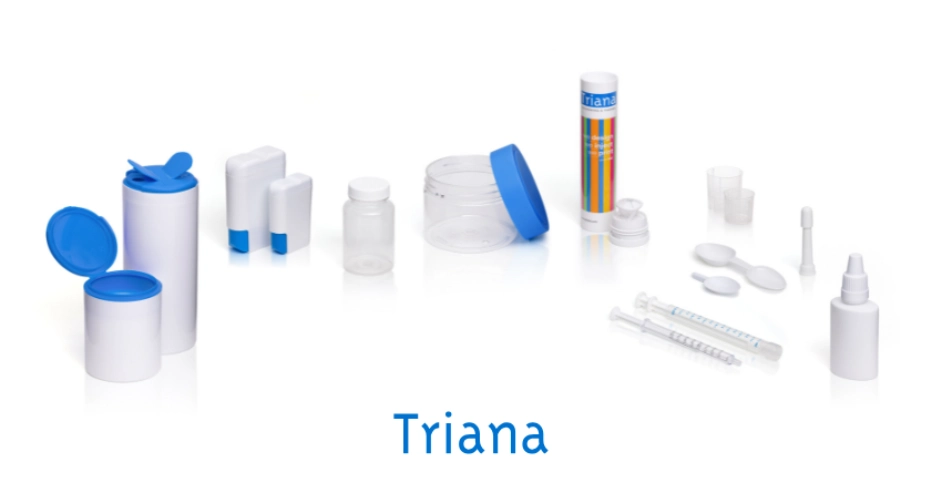
At Industrias Plásticas Triana, we already have products on the market that demonstrate how these sustainability principles are being integrated into our packaging solutions.
- Mono-Material Dispenser
We have developed a mono-material dispenser in which every component is manufactured from the same polymer.
This design allows the entire package to be recycled within a single recycling stream, eliminating the need to separate components and helping achieve the highest possible recyclability rating.
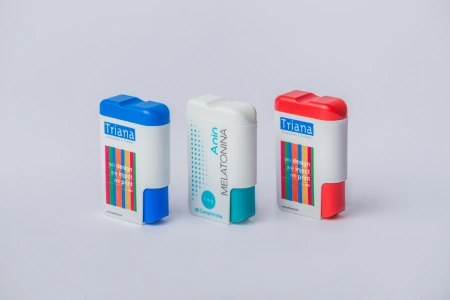
It is exactly the type of solution increasingly requested by brands and customers: functional packaging that meets all technical performance requirements while being designed for recyclability from the outset.
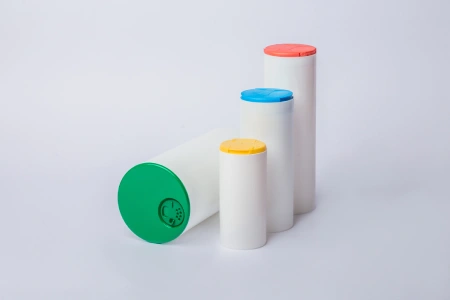
- PP Powder Dispensers
The polypropylene (PP) powder dispensers manufactured by Triana are an excellent example of packaging with genuine potential for incorporating recycled material, specifically recycled polypropylene (rPP).
In addition, PP is one of the polymers supported by the most developed recycling infrastructure in Europe.
We are currently validating formulations containing different percentages of recycled material for this product range, with the aim of providing customers with a solution that also helps reduce the tax burden associated with Spain’s Plastic Tax.
Conclusions
Sustainability in the plastic packaging industry has evolved from a voluntary initiative into a regulatory requirement.
The PPWR establishes a clear framework with defined deadlines. At the same time, customers and brands increasingly demand certified evidence of sustainability, requiring the entire industry to adapt.
In this context, packaging manufacturers capable of integrating eco-design, recycled materials, certified traceability, and regulatory expertise into their product offering will gain a genuine and long-lasting competitive advantage.
At Industrias Plásticas Triana, we are fully committed to this journey. If you would like to explore how these sustainability principles can be applied to your packaging, get in touch with us.