
In sectors such as healthcare and pharmaceuticals, quality doesn’t depend solely on the material used; the environment in which each part is packaged or handled must also be controlled.
This is where the cleanroom comes in: a production environment designed to keep specific environmental parameters under control and minimise the presence of particles and other contaminants.
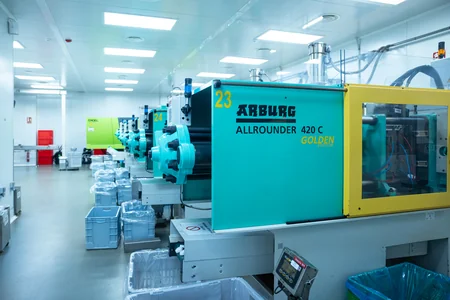
At Triana, we have operated an ISO 7 cleanroom since 1989, allowing us to manufacture and handle components in a controlled environment. Our facility currently houses 6 injection moulding machines of up to 160 tonnes, a screen printing machine for decorating oral dosing syringes and vaginal applicators, a flow-pack bagging machine using PP film, and dedicated areas for the assembly and handling of medical devices.
Below, we look at some of the key elements that keep this environment under control.
ISO cleanroom classification
Cleanrooms are classified according to the concentration of airborne particles. The ISO 14644-1 standard defines different classes based on the maximum number of particles permitted for given particle sizes.
The lower the ISO class number, the higher the level of air cleanliness required.
| ISO class | Particles ≥0.5 µm |
| ISO 1 | – |
| ISO 2 | 4 |
| ISO 3 | 35 |
| ISO 4 | 352 |
| ISO 5 | 3.520 |
| ISO 6 | 35.200 |
| ISO 7 | 352.000 |
| ISO 8 | 3.520.000 |
| ISO 9 | 35.200.000 |
Maximum concentration limits for particles ≥0.5 µm/m³ in the operational state, according to ISO classification.
It’s important to bear in mind that the required classification depends on the process, the product and the requirements of the sector it is intended for.
Air control: filtration, pressure and air changes
To maintain this classification, one of the key elements is the ventilation and air filtration system.
The air entering the production area passes through high-efficiency filtration systems designed to reduce the concentration of airborne particles and maintain the required environmental conditions. HEPA (High Efficiency Particulate Air) filters play an important role in these systems, as they can capture a high proportion of the particles present in the air.
However, maintaining the conditions of a cleanroom isn’t just a matter of installing filtration systems. For it to work properly, the various components of the HVAC system require regular verification, maintenance and monitoring.
Filtration is complemented by control of the differential pressure between areas. The cleanroom is kept at a slightly higher pressure than the adjacent areas, so that when a door is opened, air tends to flow out from the cleaner zone towards the less controlled ones. This helps prevent air from less controlled areas from getting in.
Another key parameter is the number of air changes per hour (ACH). The more often the air in a room is renewed, the greater the system’s ability to dilute and remove the particles generated during the process.
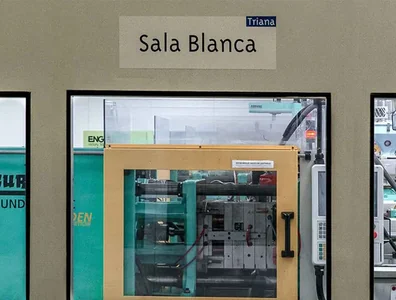
In our cleanroom, the air is changed more than 20 times per hour.
Together, filtration, differential pressure and continuous air renewal keep the environmental conditions in the production area under control. These parameters are also monitored regularly to detect any deviations in the performance of the facility.
Microbiological monitoring
Environmental control isn’t limited to particles. It is also necessary to monitor microbiological conditions in both the air and certain work surfaces.
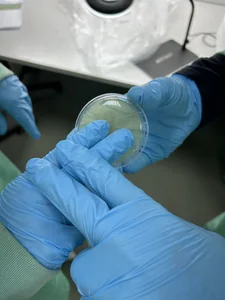
At Triana, we carry out environmental microbiological monitoring using settle plates, which allow us to assess the presence and potential growth of microorganisms in the production environment.
These checks allow us to monitor microorganisms such as bacteria, yeasts and moulds, and to confirm that microbiological conditions remain within the established criteria.
Monitoring also extends to surfaces. After cleaning and disinfection, samples can be taken using contact plates to check the microbiological condition of specific surfaces and verify the effectiveness of these processes.
Microbiological monitoring therefore provides information on both the environmental conditions and the condition of the work surfaces.
Clothing and access: controlling the human factor
People themselves are one of the main sources of particles in a cleanroom. Skin, hair, clothing fibres and even breathing constantly generate particles.
That’s why the gowning and access protocol is one of the most important control measures.
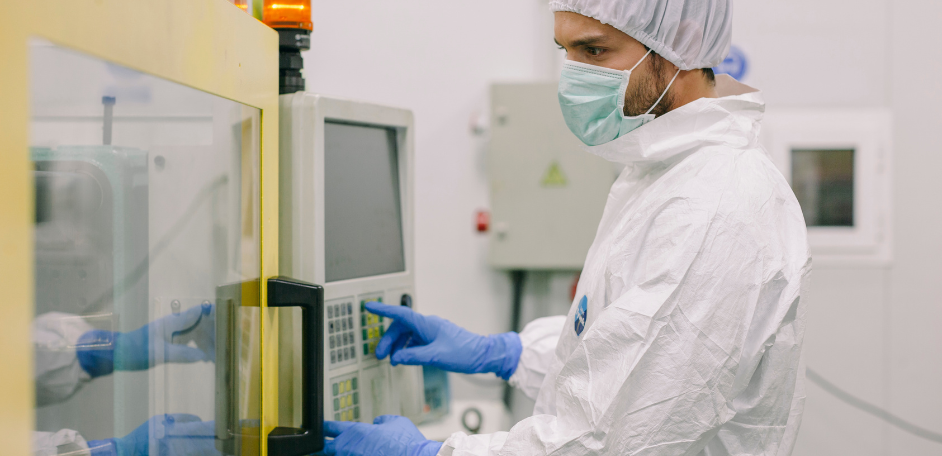
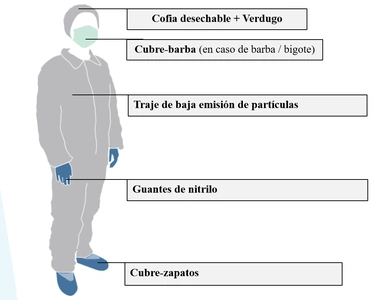
Depending on the cleanroom class, the garments may include a coverall, shoe covers, a hood, gloves and a face mask, all made from lint-free materials.
Personnel and material airlocks
Cleanrooms are never entered directly from outside. Movement between areas with different levels of control takes place through airlocks (SAS, Safety Airlock).
At Triana, we have personnel and material airlocks, which control entries and exits and reduce the risk of bringing in contaminants from less controlled areas.
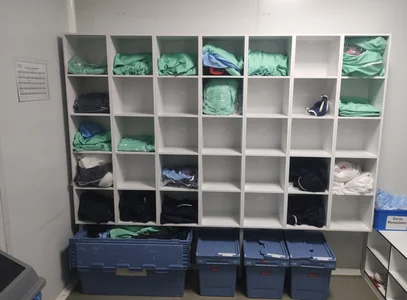
The personnel airlock is the transition area where staff change into cleanroom garments and follow the established procedures before entering the classified area.
The material airlock, meanwhile, is used to prepare and check materials before they are brought into the production area.
Staff training and qualification
Staff who access the classified areas receive in-house training on access, gowning, behaviour and working procedures within the cleanroom.
The aim is for everyone to understand how their own actions can affect environmental conditions and to work in line with the established procedures.
This is backed up by cleaning and disinfection protocols, which set out what must be cleaned, how each task should be carried out, which products to use and how often.
All cleaning operations are recorded, ensuring the traceability of the tasks carried out and making it possible to check when each one was performed.
A cleanroom is much more than a room with filters
Air filtration, air changes, differential pressure, microbiological monitoring, cleaning, gowning, airlocks, staff training and environmental qualification are all part of a single control system.
At Triana, these elements allow us to keep our ISO 7 cleanroom in the right conditions for manufacturing, assembling and handling components intended mainly for the healthcare and pharmaceutical sectors.
Combining a controlled production environment with our manufacturing processes and quality management system allows us to take on projects where process control and product quality are essential.